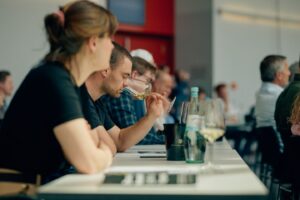
More than 3,000 trade visitors from 29 countries gathered at Mainz’s Rheingoldhalle to taste the 2025 vintage presented by 186 VDP member estates. Alongside the extensive tastings, the event once again served as one of the wine industry’s most important international platforms for dialogue around German wine—bringing together importers, retailers, and members of the press.
This year’s international attendance was particularly strong, with guests traveling from key export markets including the United States, the United Kingdom, Scandinavia, the Netherlands, Japan, China, Colombia and many other countries.
To further strengthen the professional focus of the event, the VDP also introduced an updated registration and accreditation system in 2026, reinforcing VDP.Weinbörse as a trade-only platform dedicated exclusively to qualified industry professionals.
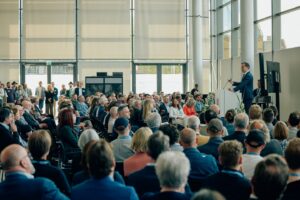
An Opening Ceremony that Highlighted Tradition, Community and the Future of German Wine
The opening ceremony on Sunday morning reflected many of the themes that shaped the weekend: an international exchange of knowledge, a commitment to origin and a forward-looking perspective on German wine.
VDP President Steffen Christmann welcomed guests by speaking about the atmosphere that has long defined VDP.Weinbörse and the importance of gathering each spring in Mainz as the new vintage begins to take shape.
Now in its 52nd year, Christmann emphasized that VDP.Weinbörse is more than a tasting event or business platform. It is also a meeting point for the people helping shape the future of German wine—both nationally and internationally.
He stressed that global recognition is something that must continually be earned through consistency in the vineyard, precision in the cellar and a collective commitment to quality.
This year’s event also coincided with the 100th anniversary of the VDP.Grape Eagle. Introduced in 1926 as the association’s hallmark, the symbol represents the VDP’s long-standing commitment to collaboration, quality and origin-driven winegrowing.
Reflecting on the anniversary, Christmann pointed to the German wine industry’s ability to continue evolving while remaining grounded in its core values.
“So I am not anxious about our future,” he said—not as reassurance, but as the confidence of an association that has measured itself against the highest standards for more than a century.
Lord Mayor Nino Haase also welcomed attendees, emphasizing the significance of VDP.Weinbörse not only for German wine, but also for the city of Mainz and the region as a whole.
Several honors presented during the ceremony highlighted individuals who have made important contributions to German wine culture over many years.
Robert Haller, longtime chairman of VDP.Franken, received a facsimile of the original VDP.Grape Eagle from 1926 in recognition of his longstanding commitment to both the region and the association.
The VDP also presented the “Herkunft Deutschland” Trophy—awarded only once in the past decade—to journalist Jakob Strobel y Serra for his journalistic advocacy for German wine and wine culture. The laudation was delivered by VDP vintner and television host Günther Jauch, who praised Strobel y Serra for helping shape the international conversation around German wine.
In his acceptance speech, Strobel y Serra spoke about the importance of protecting wine as one of humanity’s oldest cultural goods and encouraged a more thoughtful and nuanced conversation around enjoyment and wine culture.
One reflection in particular resonated strongly with the audience: “That’s when I realise what wonderful diversity wine contains, how inexhaustible its richness of flavour is, and how precious this cultural treasure truly is.”
He also described a personal evening ritual of standing before a wine shelf and selecting the bottle that best fits the moment—an image that captured the close connection between wine culture and everyday life.
The opening ceremony also included the presentation of the “Ausgezeichnetes Weinkonzept 2026” awards, recognizing outstanding wine concepts that communicate wine through expertise, hospitality and passion.
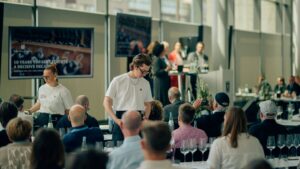
Masterclasses Offer Deeper Insight Into Classification, Prädikat Wines and Sekt
Alongside the walk-around tasting, this year’s masterclass program offered attendees the opportunity to explore some of the VDP’s key themes in greater depth, including classification, origin, Prädikat wines and Sekt.
In her masterclasses “VDP in 45 Minutes – Where Site Matters” and “Ausdruck durch Lage – der VDP in 45 Minuten,” Caro Maurer MW demonstrated how the VDP classification system can be understood directly through tasting.
Guiding participants through the VDP pyramid, Maurer used Weissburgunder from VDP.Weingut Kranz and Spätburgunder from VDP.Weingut Deutzerhof to illustrate how origin, quality and style become tangible in the glass.
Marc Almert’s masterclass, “Renaissance of the Prädikate – Positioning German Icons,” focused on the renewed international interest in Kabinett, Spätlese and Auslese wines.
Featuring wines from producers including Egon Müller, Dönnhoff, Joh. Jos. Prüm, Matthias Müller and Peter Jakob Kühn, the tasting highlighted the precision, aging potential and the growing contemporary relevance of these wines, particularly given their balance and moderate alcohol levels.
The masterclass “German Grand Crus – What Makes a Great Wine a VDP.GROSSES GEWÄCHS®?” explored the defining characteristics of Germany’s top dry wines.
Moderated by sommelier Anna Rupprecht, the discussion brought together Steffen Christmann, Dr. Ulrich Sautter, Isabella Rutayungwa, Friedrich Keller and Meike Näkel, placing German GGs in conversation with benchmark wines from regions including Burgundy and Alsace.
Rather than positioning the wines competitively, the tasting focused on sharpening the profile of the VDP system itself—highlighting the importance of origin, transparency and stylistic identity.
Sparkling wine also played an important role throughout the program.
In “VDP.Sekt.Statut – Progress & Perspective after 10 Years,” Anne Krebiehl MW reflected on a decade of development within the VDP’s Sekt framework alongside producers including Schlossgut Diel, Sektgut Barth, Forstmeister Geltz-Zilliken, Sekthaus Raumland, Ökonomierat Rebholz and Winter.
The seminar highlighted how strongly origin, patience and artisanal craftsmanship continue to shape the future of German sparkling wine.
Looking Ahead to VDP.Weinbörse 2027
Summing up the weekend, VDP President Steffen Christmann again emphasized the continuing importance of VDP.Weinbörse as an international platform for German wine.
“During the weekend of VDP.Weinbörse, Mainz reliably becomes the place where the world of German wine comes together,” he said. “For our estates, this platform is essential: it creates visibility, strengthens international relationships and brings together the people who represent our wines in the trade, gastronomy and media.”
VDP Managing Director Theresa Olkus also pointed to the strong international attendance and the depth of this year’s programming.
“VDP.Weinbörse thrives on its audience—and this year it was particularly international and exceptionally high caliber,” she said. “At the same time, the masterclasses demonstrated with impressive depth what the VDP stands for: origin, classification and diversity.”
The next VDP.Weinbörse will take place on April 25 and 26, 2027, in Mainz.
Read the VDP’s official recap here.